Grow your practice, not your payroll.

Context's AI handles the case prep for personal injury firms, so your team can handle more cases. Medical records, bills, and police reports turned automatically into actionable case insights.
Schedule a call
Sarah MitchellAuto MVADOI 3/14/24
Overview
Documents
Encounters
Chronology
Policy Limits$0Under limit
Charges$0+$6,200 unapproved
Payments$0from 14 bills
Adjustments$0write-offs
Executive Summary
Incident & Acute Findings

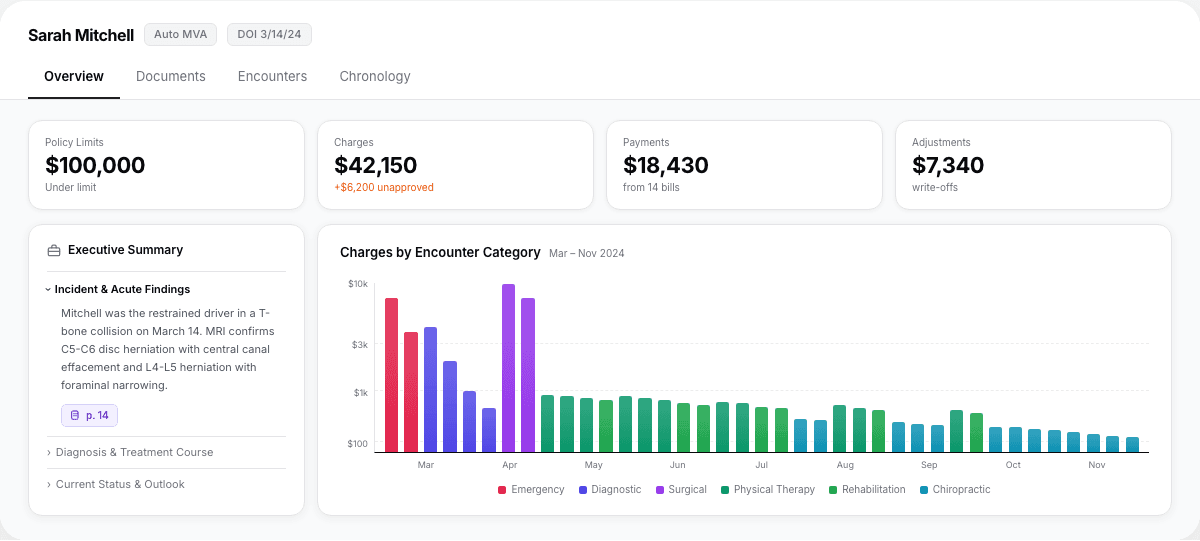
Mitchell was the restrained driver in a T-bone collision on March 14. MRI confirms C5-C6 disc herniation with central canal effacement and L4-L5 herniation with foraminal narrowing.

p. 14
Diagnosis & Treatment Course
Current Status & Outlook
Charges by Encounter CategoryMar – Nov 2024
$10k$3k$1k$100
MarAprMayJunJulAugSepOctNov
Emergency
Diagnostic
Surgical
Physical Therapy
Rehabilitation
Chiropractic

The whole file, line by line.

Context handles the paperwork, so attorneys get back to strategy and case managers get back to clients. Every case fact surfaced, verified, and traced to its source.

Incident and liability

Parties, vehicles, contributing factors, officer narrative, impairment observations, and fault indicators from police reports.

Red flags

Pre-existing conditions, treatment gaps, inconsistencies, and unrelated treatment flagged to your firm's thresholds.

Objective injuries

Imaging, range-of-motion findings, orthopedic test results, and other objective findings organized by injury.

Insurance and coverage

Liability carriers, policy limits, and UM/UIM coverage identified, with commercial policies flagged the moment they appear.

Treatment chronology

Every visit across providers in date order, from the first post-incident encounter through the latest record.

Diagnoses and clinical details

Diagnoses, medications, medical history, chief complaints, and clinical notes organized across the course of treatment.

Records matched to bills

Medical visits paired with their bills, so what happened and what it cost stay connected.

Charges by category

Emergency, diagnostic, physical therapy, chiropractic, surgical, and other charges, itemized and totaled.

Financial reconciliation

Charges matched to payments and payors, adjustments applied, specials totaled, ready for lien resolution and disbursement.

Gaps and mismatches

Visits without a matching bill, disputes on incident-related treatment, and missing records surfaced before numbers go into the case.

The whole case, reconciled.

Every medical visit matched to its bill, every charge accounted for, every flag surfaced. The full picture of the case at a glance.

Encounters
DateMedical RecordBill
Mar 14
Acute cervical and lumbar complaints following MVA
RelatedEmergency
Coastal Regional ER
$4,2003 charges
Coastal Regional ER
Apr 2
Cervical ROM deficit, lumbar imaging ordered
RelatedDiagnostic
Dr. M. Torres
$1,8502 charges
Midwest Ortho Group
Apr 18
L4-L5 disc herniation, mild foraminal narrowing
RelatedDiagnostic
Central Imaging
$3,2004 charges
Central Imaging
May 6
Lumbar stabilization, 60% flexion improvement
RelatedPhysical Therapy
Dr. S. Chen
$9001 charges
ProMotion PT

Every visit, matched to its bill

The full course of treatment with provider, specialty, and clinical notes, each visit tied to its charges and marked related or unrelated to the incident.

Coastal Regional ER
DateCodeDescriptionAmount
3/14/2499284ED visit, lvl IV$1,650.00
3/14/2471046Chest X-ray$385.00
3/14/2472100Lumbar spine X-ray$340.00
3/14/2480053Metabolic panel$165.00
3/14/2485025CBC w/ diff$98.00
3/14/2481001Urinalysis$52.00
3/14/2493005ECG$178.00
3/14/2496374IV push$112.00
3/14/24J2270Morphine inj$28.00
3/14/2496361IV hydration$192.00
3/14/2499053After-hours E/M$89.00
3/14/24A4649Surgical supply$46.00

Down to the line item

Date, CPT code, description, and amount for every charge, pulled straight from the bill.

Red flags
Pre-existing condition
Coastal Regional ER
Lumbar disc herniation documented prior to incident date on MRI from 2019, noted in the ER intake history.
Prior L4-L5 degenerative changes referenced in nursing notes but not addressed in the post-incident treatment plan.
Treatment gap
Case timeline
No records between Jan 15 ER visit and Feb 28 neurology consult, a 44-day gap with no documented treatment.
Patient reported ongoing lumbar pain during the neurology visit, suggesting symptoms continued through the gap.
Clinical inconsistency
Central Imaging
Clinical notes describe acute onset after the MVA; imaging shows chronic degenerative changes at L4-L5 with Modic type II endplate changes.
ER provider documented severe acute pain; MRI impression characterizes findings as long-standing disc disease.

Problems found before they find you

Pre-existing conditions, treatment gaps, and inconsistencies between the notes and the objective findings, flagged with the reasoning behind each one.

Context is already on it.

New documents are processed the moment they arrive in your system. No uploads, no batching, no one pressing go.

Sarah MitchellAuto MVADOI 3/14/24
Overview
Documents6
Encounters
Chronology
TypeDocumentProviderEncountersChargesStatus
Medical RecordCoastal Regional ER.pdfCoastal Regional ER18$42,150Unapproved
Medical BillCoastal Regional ER Bill.pdfCoastal Regional ER14$4,200Unapproved
Medical RecordProMotion PT — Session Notes.pdfProMotion PT9$8,100Unapproved
Medical BillProMotion PT Bill.pdfProMotion PT9$8,100Unapproved
Medical RecordCentral Imaging MRI Report.pdfCentral Imaging3$3,200Unapproved
Police ReportAustin PD Crash Report.pdfAustin PDUnapproved
  1. Documents found automatically
    01
    Documents found automaticallyRecords, bills, and police reports sync from the systems you already use.
  2. Documents become case facts
    02
    Documents become case factsEncounters, charges, diagnoses, injuries, and liability facts are extracted from every page.
  3. Findings link to source pages
    03
    Findings link to source pagesEvery finding points to the exact language in the record it came from.
  4. The case file fills itself in
    04
    The case file fills itself inReviewed findings flow straight into your case file, in the system you already use.

Built around the core of every case file.

Medical records, bills, and police reports each tell a different part of the story. Context reads each one differently.

Medical Records

The treatment record is organized around the injuries, visits, providers, and gaps that shape the medical story.

Learn more

Medical Bills

Every charge itemized, totaled, and checked against the incident, with payments and adjustments applied.

Learn more

Police Reports

The incident organized around fault, exposure, parties, and coverage, all shaping the liability picture.

Learn more

The UI is optional.

Everything Context extracts, reconciles, and flags delivered via API into the case systems and tools you already run.

Structured output

Receive clean case findings with encounters, charges, codes, liability facts, and provider details.

Source traceability

Keep every finding connected to the exact source page, ready for auditing and verification.

Own the experience

Present the findings your way, in your case system, your dashboards, or your client portal.

FAQs

Answers to frequently asked questions about Context.

No. Context plugs into the systems you already run. It does not replace your case management system; your CMS stays in place.

The treatment story, billing picture, and liability facts from your documents in one place: injuries, chronology, matched visits and charges, and red flags worth a second look. Every finding ties back to the page it came from.

Every finding ties to the page in the source document where it appears. Your team can verify everything against the original PDF and sign off before anything informs the case.

Documents sync from the systems your team already uses. Medical records, bills, and police reports are picked up as they arrive, without a separate file workflow.

ChatGPT is a chat window: someone pastes in pages and gets answers with no connection to your files, no source citations, and no memory of the case. And on a personal account there's no BAA, no control over where client medical records go, and no guarantee they aren't retained or trained on. Context is different on both counts: it's connected to the case file itself, reads every document as it arrives, ties every finding to its source page, and flags issues without being asked. And it's built for this data, HIPAA-compliant, covered by a BAA, with security configured at the firm level instead of left to whoever's logged in.

Context takes the reading, sorting, and totaling off your people's plates so the same team takes on more cases. Attorneys get their time back for strategy; case managers run more files instead of chasing pages. Nobody gets replaced; everyone gets leverage.

See Context on a real case.

Schedule a call and we'll walk through a real case: what gets found, what gets flagged, and how your team verifies it.

Schedule a call